

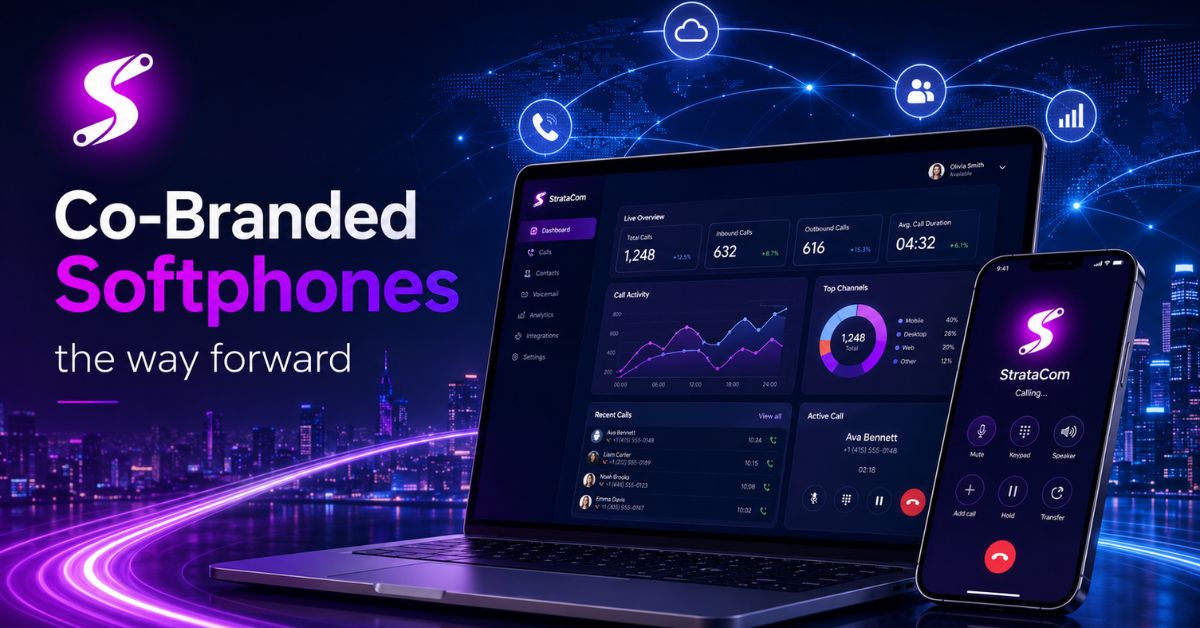
There is a quiet structural shift happening in the channel. The companies who used to resell communications — VoIP resellers, MSPs, IT service providers — are no longer content to be the middleman handing customers off to someone else’s branded app. They want the customer relationship. They want the brand on the screen. What they don’t want is to build, host, and maintain a WebRTC-to-SIP platform from scratch.
That tension — own the customer, don’t own the infrastructure — is what the co-branded softphone exists to solve.
This piece is for anyone evaluating that path: how it works in practice, what it costs you and earns you, and where we think this category is heading over the next few years.
What “co-branded” actually means (and why it matters)
The industry talks loosely about white-label softphones. In practice, most providers offer one of three things, and they are not the same.
A white-label softphone in the strict sense is rebranded entirely — your logo, your name, no trace of the underlying vendor. That sounds appealing until you discover the operational cost of it: you become the support desk, the platform’s reputation, the upgrade path. Customers do not care that the codec stack is someone else’s; if a call drops, it’s your phone that dropped it.
A co-branded softphone is different. The interface carries your brand — your logo, your colours, your menu items — with a small Powered by Siperb line tucked into the corner. Your customer sees your company. The underlying engineering, security posture, and update cadence sits with the platform provider. You get the brand equity; you skip the engineering team.
A resold softphone is just reselling someone else’s branded app. The customer knows it’s not yours. There is a margin in it, but no moat.
The middle option is where the commercial logic is most defensible. It lets a five-person MSP look like a national VoIP carrier without any of the infrastructure liability that comes with actually being one. For a fuller treatment of how this fits inside the Siperb platform, the Co-branded Softphone reference page on our knowledge base walks through the architecture in detail.
The practical layer: what you actually ship
Here’s what shipping a co-branded softphone looks like from a delivery standpoint.
You become what Siperb calls a Domain Owner. Your customers register inside your domain. They download an app — from the web, Windows, macOS, Linux, iOS, Android — and the interface they see is yours. Logo, app appearance, and up to three custom menu items in the fly-out menu pointing to whatever you want: your support portal, your billing page, your knowledge base.
Behind the scenes, two connection modes are available. The proxy mode is the default — your users register to Siperb’s secure proxy servers, which then bridges to your PBX or telephony system. This is the right choice for stability and security across diverse network environments. The WebSocket mode is direct: peer-to-peer between the softphone and your PBX, lowest possible latency, suitable when you control the network or when you’re operating in latency-sensitive contexts. The WebRTC to SIP proxy article explains the underlying mechanics if your engineering team wants to dig in.
User management is now a single action — Add User, Remove User. That sounds trivial, but anyone who has run an invite-and-confirm flow at scale across hundreds of seats knows it isn’t. Domain User seats can be reassigned freely between people, which matters more than it sounds for organisations with churn or seasonal staffing.
You handle first-line support. Siperb handles the platform — codecs, transcoding (PCMU, PCMA, G722, OPUS, G729, G729a), mobile push reliability, security patching, infrastructure uptime. The division of labour is clean.
The commercial layer: where the money is
The commercial case for co-branding has changed in the last eighteen months, and most channel partners haven’t fully reckoned with it yet.
Communications has been quietly commoditising at the infrastructure layer — SIP trunks, PBX licences, hosted PBX seats — for the better part of a decade. Margins on raw trunking are thin and getting thinner. Where the margin has expanded is at the relationship and brand layer: managed services, bundled IT-plus-comms, vertical-specific deployments. Industry analysis broadly tracks this — the UC and contact-centre segments continue to grow at compound rates that the trunking layer simply does not, with global UCaaS forecasts pointing to sustained double-digit growth through the end of the decade.
A co-branded softphone slots into the high-margin layer, not the low-margin one. You’re not selling minutes; you’re selling your communications product, with your name on it, embedded inside whatever bundle your customers already buy from you.
The pricing structure makes the model workable for small operators too. Siperb’s Domain User seats sit at £0.50 per seat per month, swappable freely between users. That gives a reseller meaningful headroom to mark up — typically 4× to 10× depending on the bundle and the local market — while still landing well under the cost of the customer building their own equivalent. The maths on a hundred-seat customer is good. The maths on a thousand-seat customer is very good. You can look at the underlying pricing model directly.
The visionary layer: where this is going
Step back from the channel mechanics for a moment.
What’s actually happening is that the unit of competition in business communications is shifting. For thirty years, the unit was the PBX — the thing you bought, installed, and depreciated. Then for fifteen years it was the hosted seat — the thing you subscribed to per user per month. Now, increasingly, the unit is the experience — the branded interface the user actually opens to make a call, and the integrations that experience plugs into.
That shift favours the people who own the customer relationship over the people who own the trunking. It favours specialisation by vertical and by region over horizontal scale. And it makes WebRTC — open, browser-native, integration-friendly — the structurally dominant transport, because the experience layer can’t tolerate the install-and-configure friction that the old softphone generation demanded. The What is WebRTC primer covers the technical case if it’s useful background; the W3C’s WebRTC specification is the canonical reference for the protocol itself.
What this means concretely: in five years, we expect the dominant communications brand inside a given business not to be the brand that owns the carrier infrastructure. It will be the brand that owns the customer’s IT relationship — the MSP, the integrator, the vertical specialist. That brand will sit on top of an infrastructure layer it didn’t build, and it will be perfectly profitable doing so.
This is the bet co-branding lets you take. It is, in our view, the correct bet.
Where to start
If you’re a reseller, MSP or IT provider thinking through this, the honest sequence is:
- Get a working understanding of the platform on your own first. Set up a Siperb softphone account, connect it to a test PBX (Asterisk, FreeSWITCH, or any SIP-compliant system — see the Asterisk WebRTC guide for the most common path), and run real calls through it. You cannot sell what you haven’t used.
- Cost out a representative customer — say, fifty seats — under your existing pricing model and under a co-branded model. Compare the gross margin on each, then factor in the support load each one places on you.
- Talk to us about provisioning a domain. The Getting Started as a Domain Owner walkthrough is the technical starting point; the commercial conversation is a separate one and we’re happy to have it directly.
For more on how Siperb fits together as a platform — the SDK, the softphone, and the co-branded layer — see our About Us page or get in touch via Contact Us. We answer.
Siperb is a UK-registered WebRTC-to-SIP platform offering a free hosted proxy service, a softphone available on every major platform, an SDK for developers, and a co-branded option for channel partners. The core Browser Phone code is open source on GitHub.
Leave a Reply